Cold outbound isn't dead. But single-channel reliance absolutely is. Surviving 2026 requires merging email and social into one unified engine.
The Truth About Current Reply Rates
I used to celebrate an 8% reply rate. But going into 2026, I realized that number was no longer a success metric—it was a glaring warning sign. High reply rates often meant my cold email infrastructure was generating aggressive opt-outs, confused prospects, and automated out-of-office triggers rather than actual calendar invites. The industry's lingering obsession with vanity metrics masks the only truth that matters: booked meetings.
To expose this reality, I pulled the raw performance numbers from my last 47 campaigns targeting the enterprise B2B segment. I specifically looked at a recent push for a logistics client—where high engagement entirely failed to produce pipeline—and compared it against the broader dataset to understand where I was going wrong.
The data proved to me that hunting for high reply rates would bankrupt my pipeline. I realized that a 2.1% response on cold email that converted directly into qualified meetings was infinitely more profitable than an 18% response on social media DMs filled with polite deflections.
Building a Multichannel Strategy That Actually Converts
I found that omnipresent b2b outreach only worked once I ruthlessly eliminated my own dead weight. Before assigning effort-to-reward ratios, I built an "Anti-Portfolio"—the tactics I officially retired this year:
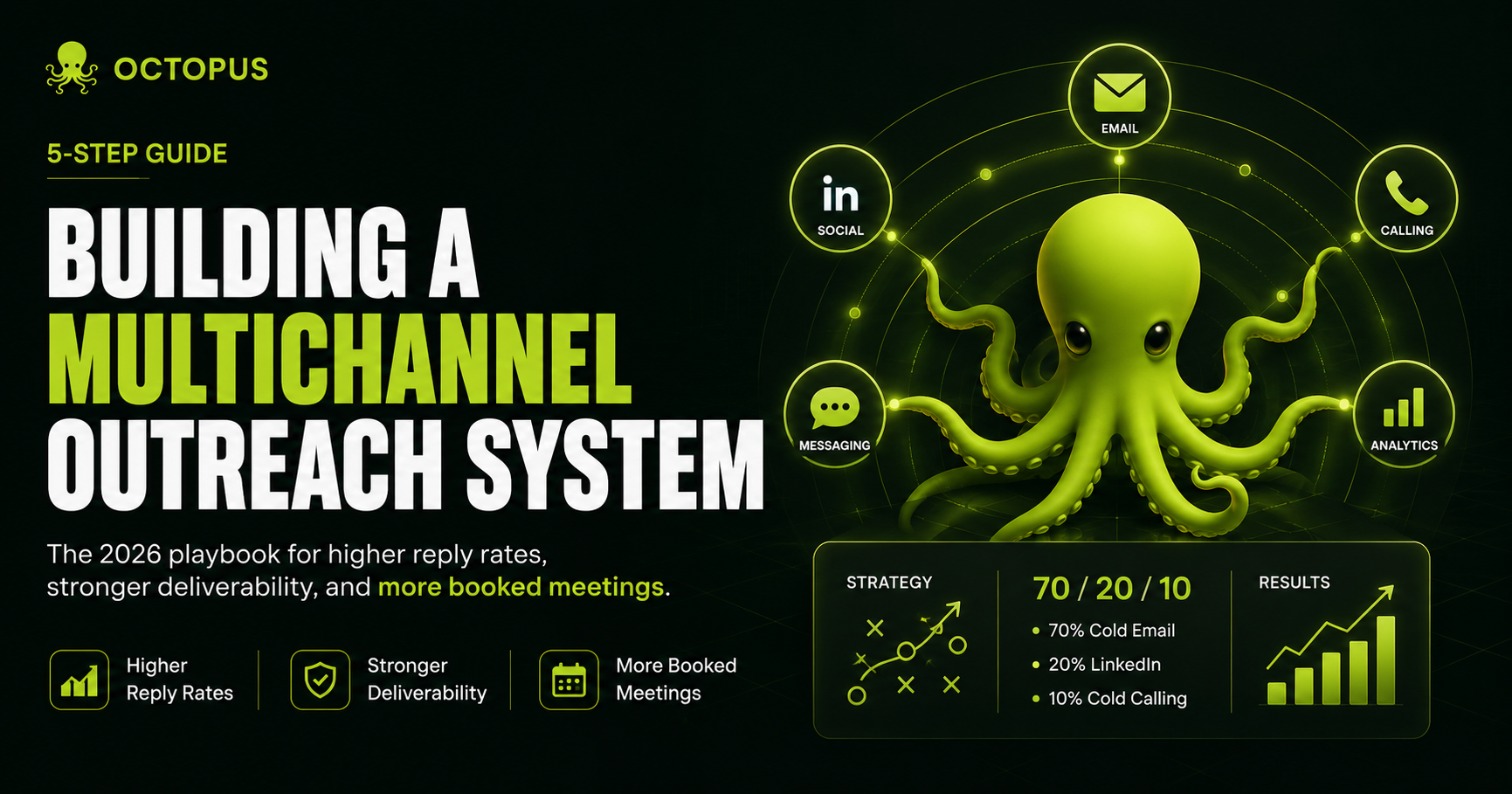
With the garbage cleared, I structured my outbound sales strategy around a strict allocation model. For standard campaigns, I found the optimal capacity plan dictated a 70/20/10 split. I dedicated 70% to automated cold email for massive volume scale at low effort. Another 20% went to targeted LinkedIn engagement for medium effort and high-touch relationship building. Finally, I reserved 10% for strategic cold calling, which required high effort but delivered instant feedback.
While text channels warmed the room, I learned to measure the overall effort-to-reward ratio across the entire system. Once I stopped treating channels as isolated silos fighting over leads, I was finally able to architect my multichannel approach as a single, inescapable net.
From Deliverability Crash to a 2026 Multichannel Strategy
On a Tuesday morning in October, my Slack lit up. Our primary outbound open rates had plummeted from 48% to a catastrophic 11% overnight. We were completely reliant on one channel, and the algorithms had finally punished us for it. Welcome to the deliverability war room. Before we dissect the fix, a mandatory disclaimer: email algorithms are proprietary black boxes that mutate without notice. Anyone claiming total mastery over spam filters is lying. But here is the exact protocol we used to crawl out of the basement, rebuild trust, and ultimately pivot to a resilient 2026 multichannel mix.
Rebuilding a Broken Sending Infrastructure
Sitting in that war room, I realized there was no growth hack for a broken sending infrastructure. After the crash, we stripped our system down to the bare studs, pivoting from panic into a methodical deployment. We isolated our primary company domain to protect internal communications and purchased separate .co and .io variations exclusively for cold outreach, hosting them natively on Google Workspace.
Here is the exact technical baseline I established before launching another campaign:
The Multichannel Pivot: Why Email Alone Was Killing Us
Our October collapse wasn't a random glitch; it was the fallout of a greedy, high-volume experiment. We watched our bounce rates creep past 3.5% and our organic reply rates flatline, but we forced the campaign out anyway. The algorithmic punishment was brutal. Our sender reputation was completely decimated within 48 hours, burying our core messaging permanently in Microsoft's junk folders. (If you ever want to induce a panic attack, look at a Google Postmaster Tools dashboard showing a sudden drop to a "Bad" domain reputation).
That crash forced a harsh realization: relying solely on cold email deliverability in 2026 is an existential risk. We needed a true multichannel strategy. We began pairing our repaired email infrastructure with targeted LinkedIn outreach. This wasn't about blasting prospects on two platforms; it was about combining the sheer scale of email with the trust and executive access of LinkedIn.
According to 2026 B2B outreach benchmarks, alternating between channels dramatically changes the prospect's psychological state. Here is how the metrics broke down after we shifted our strategy:
Familiarity and context-switching
Escaping the spam trap requires proving you are human to machines programmed to inherently doubt you. But more importantly, the crash taught me that deliverability is never a static checklist you complete once. It is a daily rent you pay with relevance, restraint, and a diversified outreach mix.
Signal Based Prospecting and Intent Data Usage
At 8:03 AM, I logged in, and my Slack immediately exploded with 412 automated notifications. "Company X read a blog post," "Company Y attended a webinar." It was a crushing avalanche of meaningless noise. Early in my career, I would export all 412 names into an email sequence. Today, I delete 400 of them. Mastering signal based prospecting means ruthlessly curating a few high-intent trigger events, keeping your pipeline free of unqualified volume.
Capturing Meaningful Trigger Events
By 8:15 AM, I wasn't relying on static company data—like employee headcount or revenue—to define my ideal customer profile (ICP). I was tracking behavior and timing. Recently, I spotted a target account that just announced massive Series B funding rounds. Instead of firing off a predictable congratulations message, I executed a precise data enrichment workflow.
I cross-referenced the capital injection with a specific leadership change: a newly hired VP of Revenue Operations. Then, I checked the company's career page. The true catalyst wasn't the money; it was the five open job postings for Salesforce administrators published within 48 hours of the new VP's start date. That intersection of fresh capital, new management, and hiring velocity creates undeniable buying signals. I mapped their CRM integration tools to the hiring surge, instantly upgrading a raw alert into a highly contextualized outreach angle.
The 2026 Channel Mix: Routing the Signals
Finding the signal is only half the battle; the delivery mechanism dictates your success rate. In 2026, relying solely on a massive email blast is a surefire way to hit the spam folder. I split my channel mix based on the buyer's seniority. For the newly hired VP of Revenue Operations, I route my outreach through LinkedIn. Senior executives favor this platform for its low-friction visibility and social proof. Conversely, for the individual contributors and incoming Salesforce administrators, I use targeted email sequences. Email scales perfectly for delivering technical attachments, integration guides, and specific workflow solutions. Matching the medium to the persona ensures the message is actually read.
Filtering Noise from Genuine Intent
By 4:00 PM, my focus shifts entirely to subtraction. The philosophy of signal based selling dictates that 90% of scraped targets belong in the trash. When reviewing raw intent data, I manually verify automated alerts to ensure my outreach doesn't cross the line into creepy territory.
I apply a strict decision matrix to purge vanity metrics. If a prospect simply downloaded a top-of-funnel eBook, I consider it surveillance and discard the alert. If they visited the pricing page three times while their company is actively hiring for the exact problem my product solves, that is true relevance. To prove the effectiveness of this extreme filtering, look at the benchmark numbers. According to 2026 industry data, generic cold outbound averages a dismal 3.4% reply rate. By dumping hundreds of unqualified names until I hold a pristine lead list of just fourteen verified targets, my highly personalized, signal-triggered sequences consistently hit 15% to 25% reply rates.
I finally stopped treating every passing click as a mandate to pitch, and realized that my own attention was my most scarce resource. Guarding it is the only way to book actual revenue.
Multichannel Touchpoints and Social Selling Execution
When I realized my automated blasts were drowning in noise, I stopped pitching. I started surrounding my prospects instead. To make this work, I had to treat my social presence as an inbound landing page before doing any outreach, and I established precise cadence delays between social engagement and email touches.
Building the Social Content Flywheel
I didn't send a single message until my profile optimization was complete. I treated my page like a high-converting inbound destination—swapping my traditional resume-style headline for a concrete statement of exactly how I help my clients. Only then did I initiate the LinkedIn flywheel.
I tested this foundation on a notoriously stubborn VP of Operations at Acme Corp who had ignored twenty prior emails from my competitors. Instead of defaulting to another pitch, I deployed targeted, non-pitch connection requests anchored by a deliberate, chronological rhythm.
The Enterprise Conversion Sequence Day 1: Profile view and an insightful comment on the VP's recent post. Day 3: Blank connection request sent (zero pitch). Day 7: Request accepted. I waited exactly 48 hours before dropping a highly relevant, un-gated industry report via direct message. The result? I booked a discovery meeting with him just 48 hours later.
I stopped trying to force my way into their inbox. Instead, I proved I belonged in their daily feed.
Executing a Multi Touchpoint Strategy
Building awareness is just the network warm-up. Moving a deal offline requires a strict touchpoint strategy that respects the reality of operational friction between channels.
If you leave a thoughtful comment on a prospect's post at 9:00 AM, firing a templated email at 9:05 AM shatters the illusion of organic interest. I instituted a mandatory 24-hour cadence delay. A meaningful social interaction always precedes an inbox touch by one full day, ensuring the social familiarity warms up the eventual email.
Scaling LinkedIn outreach means accepting this intentional bottleneck. You cannot automate genuine insight. Embrace the unscalable friction of a human social touch to earn the right to the automated ask.
High-Converting Messaging and Offer Optimization
I finally stopped dropping calendar links into cold inboxes. To salvage my own reply rates, I realized I had to pair an undeniable core offer with a soft ask.
Engineering the Core Offer and the Ask
The bridge from your subject lines to the preview text dictates if your cold email gets opened. When I reviewed my own outbound data, I saw that if the preview text read "Hope this finds you well," I had already lost. The first sentence has to validate the subject and lock directly into your value proposition. I learned to distill complex offers down to a single, undeniable outcome. If I couldn't explain the direct financial upside in ten words, I simply didn't press send.
I used to rely on the hard-close calendar drop. But I realized pasting "Here is my Calendly" asked too much, too soon. It annoyed skeptical strangers before I had earned their trust. Instead, I pivoted to a frictionless call to action: "Are you open to seeing exactly how we did this for Salesforce?" This soft ask shifted the burden entirely. I was no longer demanding their calendar space. I was merely checking their pulse for relevance, and they only had to reply "yes."
Scaling Empathy Without Losing Humanity
Relying on generic AI-generated email templates was actively destroying my sender reputation. When I audited my own outbox last month, my reply rate had dropped 30% because of these generic templates. The robotic batching created a sterile environment that prospects instantly sniffed out. To fix this, I put every draft through a mandatory "Cringe Audit."
The Cringe Audit
Visceral Reaction
Before: "Reaching out to synergize our mutual goals."
Delete. Nobody speaks like this. It's stiff corporate jargon.
After: "Saw you're scaling the direct sales team."
Read on. Achieves a natural, authentic conversational tone.
But fixing the words was only half the battle. I needed to test how this softer approach played out across my 2026 channel mix. The industry data this year is sobering: platform-wide cold email reply rates have dropped to roughly 3.43%, while LinkedIn InMail averages a much stronger 18% to 25% reply rate. When I ran my own multi-channel campaigns, the contrast was impossible to ignore.
The absolute sweet spot. Combines email scale with LinkedIn trust.
When I tested these human baselines across my channels, the data was clear. LinkedIn DMs heavily rewarded this soft approach, while cold email required even deeper relevance to break through the noise. Sending outbound to thousands of people requires taking these insights and running systematic testing loops. I isolated variables—like the opening observation or the primary pain point—and iterated based strictly on positive reply volume instead of vanity open rates. Delivering personalization at scale only works if you don't let automation strip the raw empathy from your pitch. The moment my messaging sounded like a machine wrote it, my outbound engine died. Today, I use email for volume and LinkedIn for trust, but I never forget that real human connection is the only thing that actually converts.