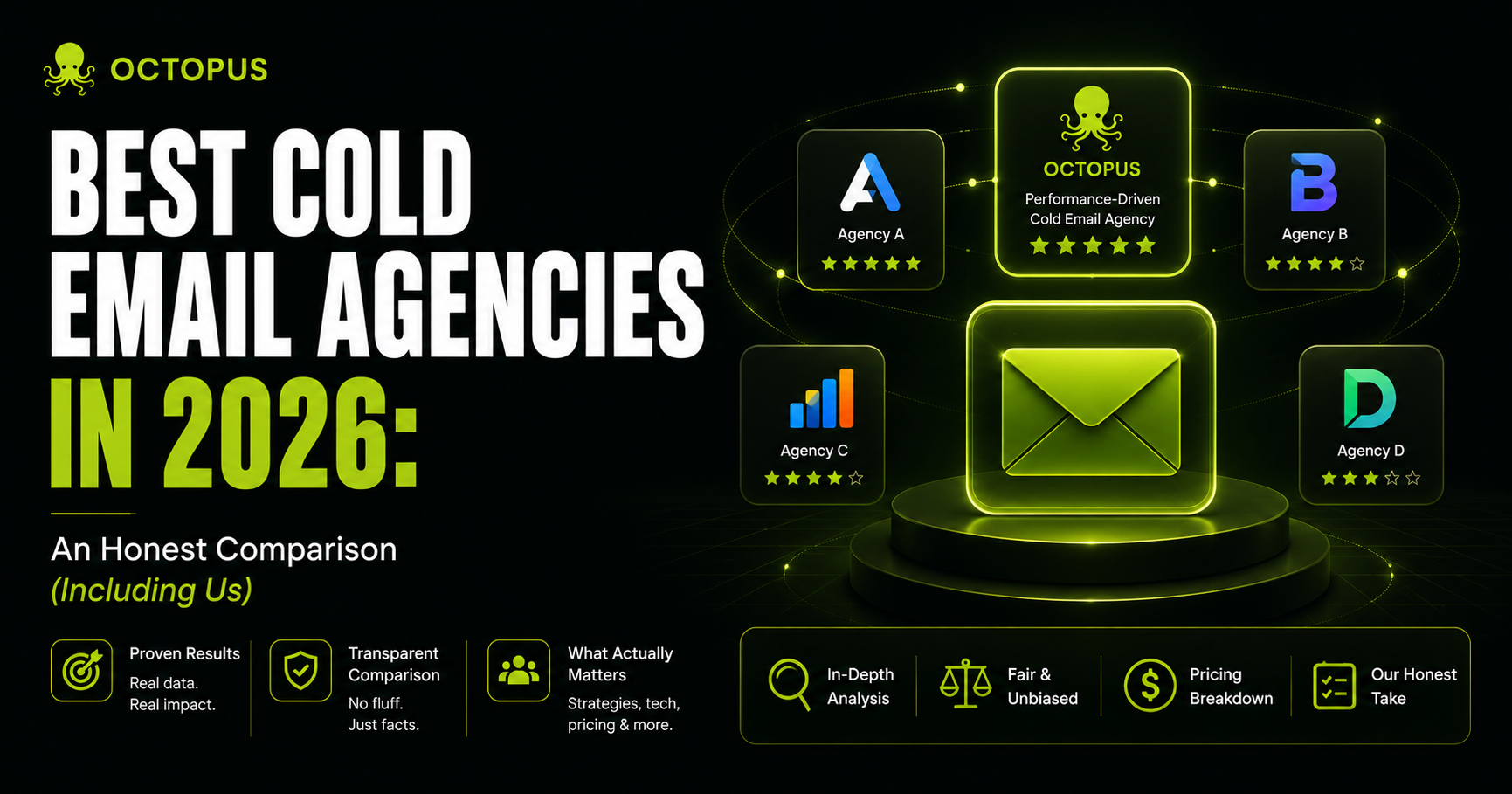
Choosing a cold email agency in 2026 requires more than comparing promises or meeting counts. You need to assess targeting, deliverability, messaging, reporting, pricing, and the agency’s fit for your sales process.
The right agency can help you build a reliable outbound pipeline, but the best choice depends on your market, goals, budget, and level of involvement. This comparison examines leading providers, explains how to evaluate their strengths, and shows where our service fits.
You’ll also find common pricing models, practical questions to ask before hiring, and clear guidance for choosing a partner that supports sustainable outreach rather than short-term volume.
You should assess an agency across five connected areas: strategic fit, prospect accuracy, inbox placement, message quality, and measurable revenue impact. A strong provider can explain its process, show relevant evidence, and identify where its work ends and your sales team’s responsibilities begin.
A capable agency starts with your ideal customer profile (ICP), not a generic industry label. It should define company size, location, technology use, business model, buying triggers, decision-makers, and exclusion criteria. These details determine whether the campaign reaches prospects with a plausible reason to respond.
Your agency should also connect the offer to a specific business problem. “We help companies grow” provides little direction; “we reduce invoice-processing time for regional logistics firms” gives the campaign a clear position. Ask how the agency tests segments, offers, subject lines, calls to action, and campaign sequences.
The strategy should match your sales cycle. A transactional service may need a direct meeting request, while an enterprise solution may require educational content and several relevant touchpoints. Agencies that rely on high volume without clear targeting can create activity without qualified opportunities.
Data quality affects every downstream metric. Your agency should explain where it obtains contact records, how it verifies email addresses, and how often it refreshes information. Ask whether it checks job changes, company status, role relevance, duplicate records, and generic addresses such as info@company.com.
A reliable process combines firmographic and individual data. Firmographics might include revenue, employee count, location, industry, and funding stage. Individual criteria should confirm that the recipient has responsibility for the problem your offer addresses.
You should also review compliance practices. The agency needs a process for honoring opt-outs, suppressing existing customers or competitors, and following applicable privacy and marketing rules. Request sample records or a data-quality report rather than accepting a general claim that its database is accurate.
Deliverability determines whether your messages reach the inbox before anyone can evaluate the copy. Your agency should use properly configured sending domains, authentication standards such as SPF, DKIM, and DMARC, sensible sending limits, bounce monitoring, and suppression lists.
Ask whether the agency separates campaign infrastructure from your primary corporate domain. A dedicated setup can reduce operational risk, but it still requires careful configuration and monitoring. Domain rotation, unlimited mailbox creation, or aggressive volume increases should not substitute for sound targeting and gradual sending practices.
You should receive clear information about bounce rates, spam complaints, domain health, and reply handling. The agency should pause or adjust campaigns when technical signals deteriorate. It should also explain how it protects your brand from misleading subject lines, excessive follow-ups, and messages sent to invalid or unsuitable contacts.
Effective copy reflects the prospect’s situation without pretending to know facts that have not been verified. Personalization should connect a real observation—such as a hiring pattern, product launch, expansion, or operational change—to a relevant business problem.
Ask to review sample messages before signing. Strong copy usually includes a clear reason for contact, a concise explanation of potential value, one straightforward call to action, and an easy way to decline further messages. It avoids unsupported compliments, vague claims, excessive formatting, and multiple competing requests.
You should also examine how the agency tests messages. Useful tests isolate one variable at a time, such as the offer, opening line, audience segment, or call to action. The agency should evaluate qualified replies and booked meetings, not just open rates, which can be incomplete or distorted by email privacy features.
Your reporting should show what the campaign produced and whether those outcomes fit your sales process. At minimum, request delivery volume, bounce rate, positive reply rate, negative reply rate, opt-outs, qualified conversations, meetings booked, meetings held, opportunities created, and revenue where tracking allows.
The agency should define each metric in writing. For example, a “positive reply” might express interest, request information, or refer you to a relevant colleague; it should not include an automated response or an unrelated question.
Attribution requires accurate handoffs. Your CRM should record the campaign, audience segment, contact, meeting status, opportunity stage, and eventual outcome. Ask how the agency handles replies, calendar bookings, no-shows, duplicate leads, and deals influenced by multiple channels. Reports should help you decide what to change, not merely confirm that emails were sent.
Your best option depends on deal size, sales-cycle complexity, technical depth, and the channels your buyers use. Compare agencies by delivery model, targeting quality, reporting, and whether they manage replies or only generate them.
Enterprise teams usually need more than email sending. You need account research, contact validation, multiple stakeholders, CRM integration, compliance controls, and coordinated outreach across email, phone, and LinkedIn.
Belkins, Martal Group, and CIENCE commonly fit this model. Belkins focuses on appointment setting, Martal Group supports broader international and SaaS expansion, and CIENCE offers data-heavy, multichannel programs suited to larger sales teams. These providers may also supply SDR support rather than handing you a list of replies.
Before signing, ask how the agency defines a qualified meeting, whether you approve target accounts, and how it handles duplicate opportunities in your CRM. Enterprise engagements often cost more because they include strategy, data operations, campaign management, and human follow-up.
You need a controlled way to test outbound without committing to a large internal SDR team. Look for month-to-month terms, transparent setup fees, realistic ramp-up expectations, and ownership of domains, inboxes, campaign data, and positive replies.
Leadium is often positioned around flexible engagement terms, while providers such as OutreachBloom offer managed infrastructure, list building, copywriting, and reply management. Search results cite OutreachBloom pricing starting at $2,400 per month, but you should verify current fees, inclusions, and contract conditions directly.
A suitable agency should help you refine your ideal customer profile instead of simply increasing volume. Confirm how many accounts and contacts it researches, how quickly it responds to interested prospects, and whether your team receives qualified conversations or only raw responses.
Technical B2B campaigns require accurate positioning and credible copy. If your product serves developers, engineers, security teams, or specialized operations groups, generic personalization will usually produce weak results.
Choose an agency that can interview subject-matter experts, understand your buying committee, and distinguish technical users from economic buyers. IntentSignal and agencies focused on B2B SaaS may fit companies that need sharper segmentation and product-specific messaging, while CIENCE can suit organizations that require structured data and multichannel research.
Ask to review sample campaigns for products with similar complexity. You should also confirm how the agency handles technical objections, intent signals, unsubscribes, and deliverability. A high reply rate has little value if responses come from contacts who cannot influence or approve a purchase.
LinkedIn-led outreach suits markets where buyers actively build professional networks and where trust develops through relevant, individual communication. It works best when email supports the conversation rather than repeating the same message across channels.
Ask whether the agency uses LinkedIn for research, connection requests, direct messages, or coordinated follow-up. Clarify who operates the account, how activity stays within platform rules, and whether your team retains control of the profile and conversation history.
A strong provider should define an audience by role, company stage, geography, and relevant trigger—not just job title. It should also coordinate LinkedIn activity with email timing and sales handoff. Avoid providers that promise fixed meeting volumes without explaining audience quality, response handling, or the steps used to prevent generic outreach.
Your best choice depends on your target market, sales cycle, budget, and preferred pricing model. Compare each provider’s targeting process, deliverability controls, campaign management, reporting, and ability to support channels beyond email.
Belkins focuses on B2B lead generation, appointment setting, and outbound sales support. You can use the agency for prospect research, email outreach, LinkedIn engagement, calling, and meeting qualification. Its broader service model suits companies that need more than campaign setup.
You should expect a structured process around defining your ideal customer profile, building prospect lists, writing sequences, and routing qualified opportunities to your sales team. Ask how Belkins validates contact data, handles unsubscribes, protects sender reputation, and defines a qualified meeting.
Belkins may fit you best if you sell to mid-market or enterprise buyers and need account-level targeting. It may be less suitable if you only want low-cost email execution or prefer to manage messaging and follow-up internally.
SalesBread provides done-for-you cold email and outbound lead-generation services, with an emphasis on campaign execution and booked meetings. Its approach typically includes prospect selection, copywriting, inbox management, follow-up sequences, and reporting.
You should clarify which parts of the service are performed by its team and which depend on your input. Strong results require accurate positioning, a clear offer, credible proof, and fast follow-up after a prospect responds. No agency can compensate for a weak market fit or an unclear sales process.
SalesBread can suit small and midsize B2B companies that want an external team to run outbound without building the workflow themselves. Before signing, confirm the expected launch timeline, minimum commitment, meeting standards, replacement policy, and whether campaign assets remain yours.
Cleverly is known for LinkedIn-focused lead generation and also offers email and broader outbound support. Its LinkedIn strength makes it relevant when your buyers actively use the platform and respond to personalized connection and messaging workflows.
You should check how the agency handles profile activity, message limits, personalization, consent, and account security. LinkedIn outreach also requires careful coordination with your sales team because prospects may respond through the platform rather than by email.
Cleverly may work well for consultants, agencies, recruiters, and B2B service companies with identifiable decision-makers. It becomes less attractive when your audience rarely uses LinkedIn, when you need highly technical account research, or when you want a campaign measured only by email-attributed meetings.
Martal Group provides outsourced B2B sales development and appointment-setting services. Its support can include market research, messaging, multichannel outreach, lead qualification, and sales development representation. You may find this useful when you need consistent prospecting capacity without hiring an internal team.
The main benefit comes from combining campaign execution with human qualification. Ask whether the assigned team will learn your product, join discovery calls, document objections, and adapt targeting based on actual conversations.
Martal Group may suit SaaS, technology, and professional-services companies with defined sales processes and higher-value deals. You should review its experience in your market, expected activity levels, reporting cadence, contract terms, and the exact definition of a sales-qualified meeting before comparing pricing.
CIENCE Technologies combines human research with outsourced SDR and appointment-setting services. Its model can include account identification, contact verification, personalized messaging, calling, qualification, and CRM support. This makes it relevant when your target market requires detailed research rather than broad list volume.
You should ask how CIENCE builds account lists, verifies job titles and buying roles, records research in your CRM, and manages data changes. You should also confirm whether the assigned team works from your sales playbook or helps refine it through campaign feedback.
CIENCE may fit companies with complex B2B products, multiple stakeholders, or larger target-account lists. Its service can require more coordination than a simple email vendor because you may need to provide sales materials, case studies, qualification criteria, and timely feedback on every opportunity.
Leadium offers outsourced sales development, appointment setting, and prospecting support for B2B companies. Its services can cover list building, email, LinkedIn, calling, lead qualification, and sales development operations. You can use it when you want an external SDR function rather than email copy and sending alone.
Evaluate the quality of its research and the experience of the representatives assigned to your account. A capable team should understand your buyer’s role, identify relevant business problems, follow your qualification rules, and record useful context for your closers.
Leadium may be a strong fit when you need ongoing outbound capacity and a multichannel process. Confirm onboarding requirements, representative coverage, reporting access, CRM integration, expected meeting volume, and how the agency handles poor-fit meetings or changes to your target market.
You get a targeted outbound system built around deliverability, accurate prospect data, relevant messaging, and measurable campaign management. The right fit depends on your sales cycle, audience, internal follow-up capacity, and whether you need email alone or a broader outbound program.
You receive a managed process rather than a list of contacts and generic templates. Campaign planning starts with your offer, target market, buying triggers, geographic focus, and qualification criteria.
We help define account and contact segments, verify prospect data, configure sending infrastructure, and develop messages for specific audiences. Campaigns typically use structured testing across subject lines, offers, calls to action, and audience segments instead of changing several variables at once.
You also get performance monitoring focused on useful indicators: delivery issues, positive reply quality, booked meetings, conversion rates, and disqualification patterns. When appropriate, the program can include additional outbound channels, but the channel mix should match your prospects’ behavior and your team’s ability to respond.
You should expect transparent reporting, clear campaign assumptions, and regular adjustments based on evidence. No responsible provider can guarantee meetings because results depend on market demand, positioning, pricing, sales execution, and list quality.
You are likely to benefit most if you sell a clearly defined B2B product or service with an identifiable buyer and a meaningful contract value. You should also have a sales process that can handle qualified replies promptly and convert meetings through consistent follow-up.
The service fits companies such as:
You do not need a large internal marketing department, but you should provide accurate information about your strongest customer segments, sales outcomes, case studies, pricing structure, and disqualifying criteria. A focused niche usually produces better campaign decisions than an instruction to contact “any company that might need this.”
You should also be prepared to review messaging and respond to sales opportunities. Outsourcing campaign execution does not remove your responsibility for positioning, qualification, and closing.
Another provider may suit you better if you need a narrowly specialized service or a different commercial model. For example, an agency with deep experience in your regulated industry may offer stronger compliance processes and domain-specific messaging.
You may prefer an email-only vendor if your team already manages prospect research, infrastructure, copywriting, reply handling, and reporting. A lower-cost platform may make more sense if you want software and internal control rather than managed execution.
You should compare providers on more than promised meeting volume. Ask about data sources, sender-domain practices, opt-out handling, reporting access, contract terms, reply ownership, and campaign approval procedures. Clarify whether pricing covers strategy, infrastructure, copy revisions, contact verification, inbox management, and booked-meeting qualification.
If you need brand-heavy account-based marketing, large-scale paid acquisition, or complex enterprise procurement support, a provider built around those functions may be a better match than a focused cold-email agency.