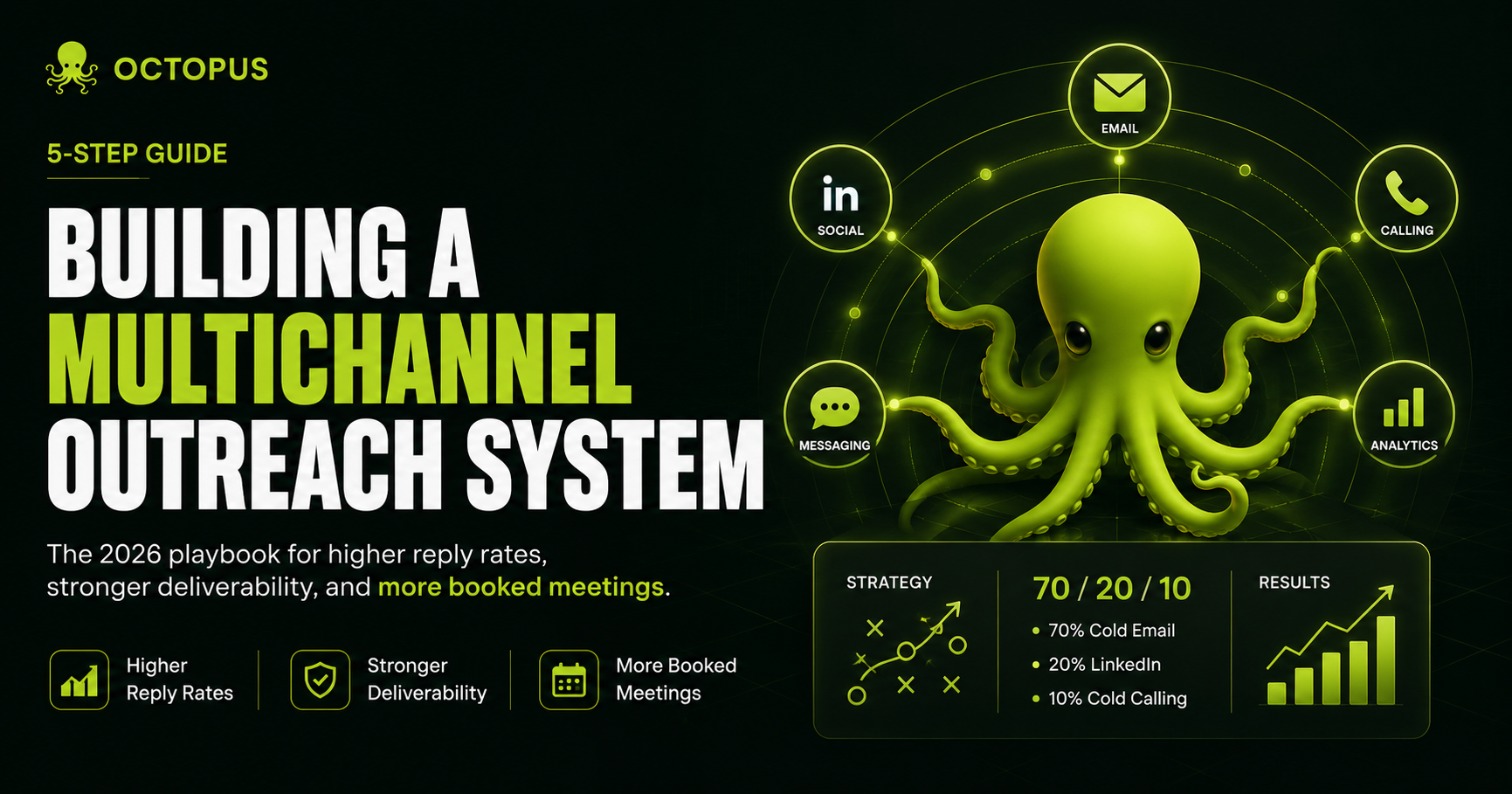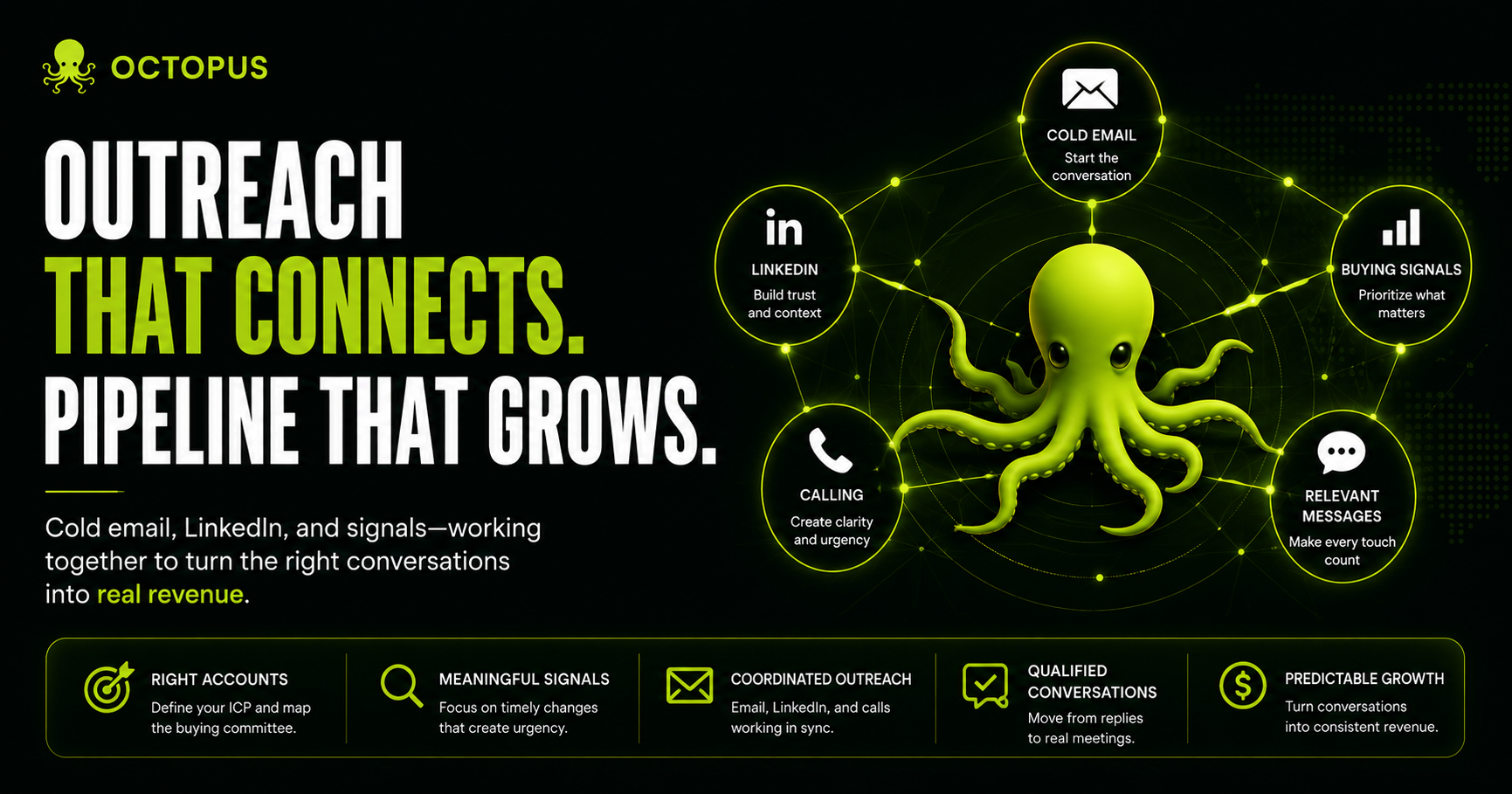
Cold outreach still works in 2026, but generic lists and repetitive sequences will not create consistent pipeline. You need a connected system that identifies the right accounts, detects meaningful buying signals, and reaches prospects with relevant messages across email and LinkedIn.
You get better results when you use signals to prioritize a focused account list, combine cold email with LinkedIn touches, and measure qualified pipeline instead of activity alone. You’ll see how to turn those elements into a practical outbound motion, from writing emails that earn replies to building sequences that support trust without overwhelming prospects.
You’ll also learn how to refine targeting, personalize outreach around real business changes, and identify which channels and messages move opportunities forward.
An effective outbound system connects account selection, buying signals, message relevance, and coordinated follow-up. You use each channel for a specific purpose while keeping the prospect, timing, and business problem consistent.
Cold email, LinkedIn, and calls work better as connected touchpoints than as separate campaigns. Email can introduce a relevant problem, LinkedIn can provide a familiar context, and a call can clarify whether the issue deserves attention. Each interaction should add information rather than repeat the same pitch.
Build your sequence around a clear account hypothesis:
Keep your records synchronized across channels. If a prospect replies, changes roles, visits a key page, or asks for no further contact, update the sequence immediately. This prevents contradictory messages and protects your deliverability and reputation.
Relevance at scale does not mean writing a completely unique message for every prospect. It means combining reliable data, meaningful signals, and modular copy that reflects the recipient’s situation. Start with a narrow ICP, then group accounts by trigger, industry, company stage, or operational problem.
Your message should connect three specific points:
Use automation for research support, enrichment, routing, and timing—not for inventing personal details. Review generated messages before sending, suppress poor-fit contacts, and test one variable at a time. Track positive replies, qualified meetings, conversion by signal, and unsubscribe rates instead of judging performance by send volume alone.
A strong account list combines a specific customer profile with a clear view of who influences each purchase. You can then use company signals to prioritize accounts and coordinate relevant email, LinkedIn, and phone outreach.
Define your Ideal Customer Profile (ICP) using evidence from your best existing customers, not assumptions. Record firmographic and operational details such as industry, employee count, annual revenue, geography, technology stack, compliance requirements, and the business problem your product solves.
Separate must-have criteria from useful preferences. For example, a cybersecurity vendor might require 250–2,000 employees, a cloud-based infrastructure, and operations in regulated markets. It might prefer companies hiring security engineers or expanding into new regions.
Add exclusion rules to protect your team’s time. Exclude companies with incompatible systems, insufficient budget, unsupported locations, or use cases your product cannot serve. Score each account against the ICP, then rank it by fit and urgency.
Map the full buying committee instead of targeting one contact. Identify the economic buyer, daily users, technical evaluators, procurement staff, legal reviewers, and internal champions. Their priorities differ: finance may focus on payback, IT on integration, and users on workflow improvements.
Use public information, customer relationship management data, company websites, professional networks, and hiring pages to identify likely roles. Track each person’s title, department, influence, relationship to the problem, and preferred communication channel.
Create account-level records so your outreach stays coordinated. A useful structure includes:
Prioritize accounts where several relevant contacts show connected signals, such as hiring for the affected function, changing leadership, visiting product pages, or announcing expansion.
You get better results when you use signals to decide who to contact, why now, and which channel to use. Combine direct engagement data with external business changes, then match your message to the event instead of sending the same sequence to every prospect.
First-party signals come from your own properties and usually deserve the highest priority. Track actions such as repeated visits to pricing or comparison pages, webinar attendance, product-demo requests, email clicks, trial activity, and visits from multiple people at the same company. A single page view may show curiosity; several related actions within a short period suggest stronger interest.
Third-party signals come from sources outside your company. These can include review-site activity, relevant content engagement, technology changes, hiring patterns, intent-data providers, and social interactions with topics related to your offer. Treat these signals as evidence, not proof of a buying decision.
Use a simple scoring model to rank accounts:
SignalExample priorityDemo request or trial activityHighRepeated pricing-page visitsHighSeveral employees researching your categoryMedium-highRelevant hiring or technology changeMediumGeneral content engagementLow
Respect privacy rules and apply frequency limits. Use the signal to improve relevance, not to reveal that you are tracking someone’s behavior.
Trigger events indicate that a company’s situation has changed. Useful examples include new funding, executive appointments, acquisitions, geographic expansion, compliance deadlines, technology migrations, and job postings for roles connected to your solution. A new operations leader may review systems; a regional expansion may create demand for infrastructure, hiring, or local support.
Act while the event remains timely. Confirm the date, identify the person responsible for the related initiative, and connect your message to a specific business consequence. For example: “Your team is hiring three implementation managers in Germany. If that expansion increases onboarding volume, we can help standardize delivery across regions.”
Avoid treating every event as an automatic sales opportunity. Combine the trigger with a strong ICP fit, a relevant contact, and a credible reason your product could help. Use LinkedIn for context and relationship building, email for a focused business case, and calls when the issue appears urgent or operationally important.
Effective cold emails connect a specific business signal to a credible value hypothesis, then make a small, clear request. You improve results by showing why the message fits the recipient now and by following up with useful context rather than repeated reminders.
Start with a signal that indicates a relevant business change: a funding round, leadership appointment, hiring surge, product launch, or technology shift. Then connect that signal to a problem you can reasonably infer. For example: “You’re hiring five implementation managers, so reducing manual customer handoffs may become a priority.”
Keep the hypothesis narrow and testable. Explain who you help, what outcome you support, and why the timing makes sense in two or three sentences. Avoid unsupported claims about revenue, internal processes, or personal priorities.
Use a simple structure:
Personalize the reasoning, not just the recipient’s name or company. If your assumption may be wrong, acknowledge that directly and invite correction.
Plan three to five follow-ups across roughly two weeks, adjusting the timing for your market and sales cycle. Each message should add something new: a relevant example, a brief observation, a useful resource, or a sharper version of the original hypothesis.
Keep every email focused on one action. Ask whether the issue is relevant, offer two possible meeting times, or invite the recipient to redirect you to the right person. Do not send “just checking in” messages that add no information.
A practical sequence might look like this:
Stop when the recipient replies, opts out, or shows no meaningful engagement after the planned sequence. Keep sending volume controlled, protect deliverability, and measure positive replies and qualified conversations—not opens alone.
LinkedIn works best when it confirms your identity, expertise, and relevance before you ask for time. A credible profile, useful activity, and carefully timed messages can make email outreach feel familiar rather than unexpected.
Treat your profile as a verification page for every prospect who receives your email. Use a clear photo, a specific headline that states who you help and how, and an About section that explains your work in plain language. Add relevant proof, such as customer outcomes, certifications, or practical examples, without turning the profile into a sales page.
Publish or share material that matches your target buyer’s problems. A short analysis of a common operational issue, a useful checklist, or a thoughtful comment on an industry post gives prospects a reason to recognize your name. Prioritize consistent, relevant activity over frequent promotional updates.
Before contacting someone, review their role, recent posts, company changes, and shared connections. Reference only information that genuinely relates to your reason for reaching out. Avoid pretending that a like or profile view creates a personal relationship.
Use a connection request to establish context, not to deliver a full pitch. Mention a specific reason for connecting, such as a shared market, relevant initiative, or professional topic. Keep the note brief and avoid links, meeting requests, and generic praise.
After acceptance, wait long enough to avoid appearing automated, then send a message that continues the original context. Offer one useful observation or ask a focused question about a problem relevant to their role. If they respond, tailor the conversation; if they do not, send one respectful follow-up and then stop.
Coordinate LinkedIn with email, but do not repeat the same script across both channels. For example:
A strong sequence coordinates email, LinkedIn, phone, and intent signals around one account plan. You improve relevance by adjusting timing and content to the prospect’s behavior instead of repeating the same pitch across every channel.
Start with a clear trigger, such as a funding announcement, hiring activity, product change, content engagement, or a role change. Use that signal to confirm account fit before you begin outreach.
A practical cadence might look like this:
Leave enough time for the prospect to recognize your name and respond. Pause the sequence when the prospect replies, asks you to stop, changes roles, or shows no fit. Log every touch in your CRM so another team member does not contact the same person with conflicting timing.
Keep the core problem consistent, but change the reason for contacting the prospect. Your email can explain a likely operational issue, your call can test whether it exists, and your LinkedIn message can offer a concise insight rather than restating the email.
Use one specific proof point per touch. For example, mention a hiring pattern in the first email, ask about its effect on the phone call, and share a relevant process improvement in the follow-up. Avoid copying subject lines, opening sentences, and calls to action across channels.
Before each touch, check the account record for prior replies, objections, content downloads, and recent activity. Remove prospects who opt out, and do not use personal or sensitive information merely because a data provider surfaced it. Personalization should clarify your relevance, not create the impression that you are monitoring the prospect.
You need to connect early engagement signals to qualified opportunities and revenue, then test one meaningful variable at a time. This keeps cold email, LinkedIn, and intent signals accountable to business outcomes rather than surface-level activity.
Track performance by account, signal, channel, and sequence, not only by individual message. Leading indicators include positive reply rate, LinkedIn acceptance rate, meaningful conversations, booked meetings, meeting attendance, and sales-accepted opportunities. Separate positive replies from automatic responses, objections, and requests to unsubscribe.
Revenue metrics show whether your targeting works. Monitor opportunity creation rate, pipeline generated per 100 accounts contacted, opportunity-to-close rate, average deal value, sales-cycle length, and sourced revenue. Compare results across signal types, such as hiring activity, funding, technology changes, or pricing-page engagement.
Use consistent attribution rules. For example, credit a sequence when it creates the first qualified conversation, while recording LinkedIn or email as the assisting channel when both contribute. Review a weekly dashboard, but judge revenue performance over a sales cycle because early-stage activity can fluctuate.
Test one major variable at a time across a sufficiently large, comparable group. Start with audience variables such as industry, company size, job role, or trigger age. Then test message elements: the opening observation, problem framing, proof point, call to action, and sequence timing.
Keep a control version so you can measure improvement against your current approach. A useful test might compare a hiring signal with a technology-change signal among similar accounts, using the same offer and cadence. Measure positive replies and qualified meetings first, then track opportunities and pipeline as those contacts progress.
Review results by channel combination, not just channel. Email may create the first response, while LinkedIn increases recognition and calling accelerates qualification. Stop tests that produce activity without qualified conversations, document winning patterns, and update your account lists, scoring rules, and templates based on verified pipeline results.